Which book of African tales to choose for your child?
This guide compares books by age and by use, including titles that are not ours. We are a publisher, so we first tell you how to judge any book of tales, then how ours measure up against those same criteria.
Ages 3-5: a picture book, a single tale, read by an adult — Rafara, Baobonbon.
Ages 6-9: a collection of short tales with a table of contents, so that each tale can be finished in one sitting — our collections 54 Tales of Africa are built for exactly that.
From ages 7-9, for an already confident reader: a comic book with an African hero — Mariam Plays Ball, The Awakening of the Jeli.
After 10: the heritage classics — Birago Diop, Bernard Dadié, Amadou Hampâté Bâ.
The ages are our editorial recommendations, not publisher labels. A child who is read to every night can follow a text earlier than a child reading alone.
The 6 criteria that really matter
They apply to every book, ours included. Each criterion comes with a way to check it in two minutes, book in hand or from a product page.
01Listening before writing: tales are collected from elders and storytellers.
Where the tale comes from
An African tale comes from a specific people and a specific country. A book that talks about “Africa” without ever naming a place was compiled, not collected.
Check: is the country or people named at the top of each tale? Does the book say whom it was collected from?
02A Studio UG plate: faces, clothing and architecture rooted in a real place.
Who illustrated it
Pictures shape the imagination. Accurate faces, gestures and landscapes call for an illustrator who knows the culture being depicted.
Check: is the illustrator named? Do the characters have specific features and clothing, or a generic “African backdrop”?
03
The length of a tale
A child reading alone should finish the tale in one sitting: 5 to 8 minutes, or 500 to 900 words. A tale abandoned halfway is not picked up again.
Check: read one page aloud and time yourself. Do it for any book — including ours.
04
A table of contents, and stand-alone tales
With a table of contents, the child chooses the tale themselves: that is what turns a reader you have to push into a reader who asks for more.
Check: open the table of contents. Can you start anywhere? Can one book be read without the one before?
05
Seeing themselves in the hero
For an African or diaspora child, a hero who looks like them and wins changes the way they see themselves. For other children, it is a window onto a world that is not just a backdrop.
Check: who drives the story? Are African children its heroes, or its subject?
06
Are African words explained?
A tale lives through its words: the name of a dish, an instrument, a tree. Removing them impoverishes it; leaving them unexplained loses the child.
Check: is there a glossary, a note or an explanation within the sentence? Have the characters kept their traditional names?
Picture book, collection, classic or comic: the right format for the child
The four formats are not interchangeable. Each one matches a stage of reading.
Learning to read starts with following a voice. Photo: USAID, public domain (CC0).
Comparison of the four formats of African tale books by age and use
Format
Who it’s for
How long a story lasts
What you gain
Its limit
Verified examples
Picture book
Ages 3-6, read by an adult
5-10 min, the whole book
One picture per page; the child follows the story without being able to read
Only one tale per book, quickly exhausted
Rafara (De Boël), Baobonbon (Ichikawa), Yakouba (Dedieu)
Collection of short tales
Ages 6-10, with an adult, then alone
5-8 min per tale
Dozens of stories, a table of contents, a different country each time
Denser text: read it with the child the first few times
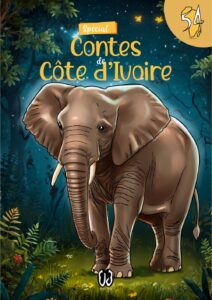
54 Tales of Africa (two volumes), Côte d’Ivoire Special
Heritage classic
After 10, or read aloud before then
10-20 min per tale
Literary language and the voice of the founding authors
Few or no illustrations; demanding vocabulary
Tales of Amadou Koumba (Diop), The Black Cloth (Dadié), Leuk-le-Lièvre (Senghor & Sadji)
Comic book
From ages 7-9, including children who “don’t like reading”
One long story, over several evenings
A hero followed over time; the pictures carry the text
It is no longer the traditional tale: it is fiction inspired by it
Mariam Plays Ball, The Awakening of the Jeli, Dissongo
Eight titles that are not ours and that we recommend without reservation. Every attribution was checked at the source before publication.
Ages 3-6RafaraAnne-Catherine De Boël
A Merina tale from Madagascar: a little girl abandoned in the forest, a monster, and three magic objects to get away. The go-to picture book for bedtime reading.
Ages 3-6BaobonbonSatomi Ichikawa
Paa sets off to sell bananas at the market and meets a talking baobab. Short, tender, and the tree is a character in its own right.
Ages 5-8YakoubaThierry Dedieu
A young boy must kill a lion to become a warrior; the lion is wounded. The book shows the choice and its consequences — a real moral question, at a child’s level.
Ages 6-9Petit BodielAmadou Hampâté Bâ
A Fula tale: a lazy little hare, his mother and the path of cunning. The most accessible of Hampâté Bâ’s texts.
Ages 8-10La Belle Histoire de Leuk-le-LièvreLéopold Sédar Senghor and Abdoulaye Sadji
Written for children as a school reader. Leuk the hare crosses the bush from one adventure to the next: the first “real book” to read alone.
Ages 10+Tales of Amadou KoumbaBirago Diop (1947)
Birago Diop set down in writing the stories of the griot Amadou Koumba. The benchmark of the written African tale: the language is beautiful and calls for a seasoned reader.
Ages 10+The Black ClothBernard Dadié
Sixteen tales from Côte d’Ivoire, with Kacou Ananzè the spider as the common thread. The other great classic, an Ivorian one this time.
Ages 10+Contes des sages d’AfriqueAmadou Hampâté Bâ, Éditions du Seuil
Stories from several traditions gathered by Hampâté Bâ himself, with a preface by Henri Gougaud. For a teenager or an adult who wants to go to the source.
What we can prove: our tales are collected from storytellers, checked by African reviewers and illustrated by artists from the continent (our method, step by step). Each collection has a table of contents and can be read in any order. What we do not claim: to replace Birago Diop. The prices below are those of our catalog of African folktale books for children, in CFA francs.
Students from a partner school, each with her own copy.
In Abidjan, Mariam wants to become a soccer star — not for a girl, says the neighborhood. The four episodes of “The New Legend of the Maracanã” collected in one volume.
Do it with the book in hand — or, online, with the preview pages on the product page.
Open the table of contents. How many tales? Are they rooted somewhere (a country, a people)? Without a table of contents, the child will depend on you to choose.
Read a page aloud and time it. Multiply by the number of pages in a tale. Beyond 8 minutes for a beginning reader, plan to read it together.
Look at the faces. Are the characters recognizable children, with specific clothing and places, or a picture-postcard Africa?
Look for where the story comes from. A “sources” page, a note on origins, the names of the storytellers or reviewers. None of that? The book was compiled from other books.
Let the child choose. Show them two covers. The one they pick is the one they will read.
Three common mistakes
Buying the classic too earlyBirago Diop at age 6 ends up on the shelf. The classic comes after the collection, not instead of it.
Confusing “African” with “exotic”A savanna backdrop with talking animals is not an African tale if it comes from nowhere.
Choosing for the childThe book you would like them to love is not the one they will open. Let them have the final say between two good books.
Frequently asked questions
Which book of African tales for a child aged 3 to 5?
A picture book, a single tale per book, read by an adult. Rafara (Anne-Catherine De Boël, a Merina tale from Madagascar) and Baobonbon (Satomi Ichikawa) are the two safe bets. A collection of 27 tales is still too dense at this age: save it for age 6.
And for a child learning to read, between 6 and 8?
A collection of short tales with a table of contents, so they can choose for themselves and each tale can be finished in one 5-to-8-minute sitting, or 500 to 900 words. That is the format of our “54 Tales of Africa” collections, but apply the read-a-page-aloud test to any book, ours included.
How can you tell whether a tale is truly African and not rewritten?
Look for three things in the book: the country or people each tale comes from, how it was collected (from whom, by whom) and the names of the illustrators. A book that says neither where the story comes from nor who recorded it was not collected, it was compiled.
What are the great classics of the African tale?
Tales of Amadou Koumba by Birago Diop (1947), The Black Cloth (Le Pagne noir) by Bernard Dadié, La Belle Histoire de Leuk-le-Lièvre by Senghor and Sadji, and Petit Bodiel and Contes des sages d’Afrique by Amadou Hampâté Bâ. Their language is literary: they suit readers over 10, or younger children when read aloud by an adult.
Should you start with Part One or Part Two of 54 Tales of Africa?
It doesn’t matter: the two books can be read independently, each covers 27 countries and has its own table of contents. Choose the one that includes your family’s country, or give both to have all 54.
Do you deliver to France?
Our online shop delivers in Côte d’Ivoire (2,000 F CFA, free from 32,800 F CFA, or pickup in Abidjan-Angré). Outside Côte d’Ivoire, our books are distributed by resellers such as La Boutique Africavivre and Amazon, depending on the title.