
School memories · Côte d’Ivoire
“Mariam joue à la balle” (“Mariam plays ball”): the first-grade reader everyone remembers (and what became of Mariam)
Published on · IVORIAN CULTURE
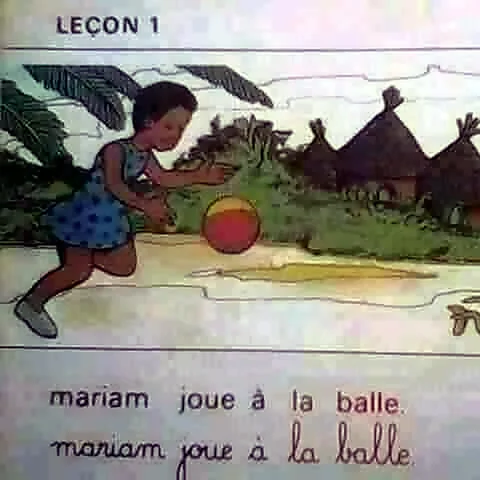
Five words that generations of Ivorians have never forgotten. If you’re looking for the old CP1 (first-grade) reader, here it is: lesson 1, the drawing, the red ball. What became of that textbook, we’ll tell you straight. What became of Mariam is another story — and she is thirty years older.
The short answer, if you’re looking for the textbook
- We don’t sell the old reader and we don’t have it: school editions from that era left the bookshops long ago.
- Where to look: Facebook groups devoted to school memories and forums about old textbooks, between private individuals. Today that is the only serious lead.
- What we do have is the sequel: Mariam Plays Ball, an Ivorian comic book inspired by that sentence — Mariam has grown up and plays maracana in Abidjan.
The exact title of the textbook, its publisher and its author are not publicly established: we won’t make them up.
A sentence learned by heart before we could even read
“Mariam joue à la balle.” (Mariam plays ball.)
For generations of schoolchildren in Côte d’Ivoire, these were probably the very first five words they ever read in one go. A sentence from a reading book, with a drawing above it: a little girl in a polka-dot dress, a ball, huts and palm trees.
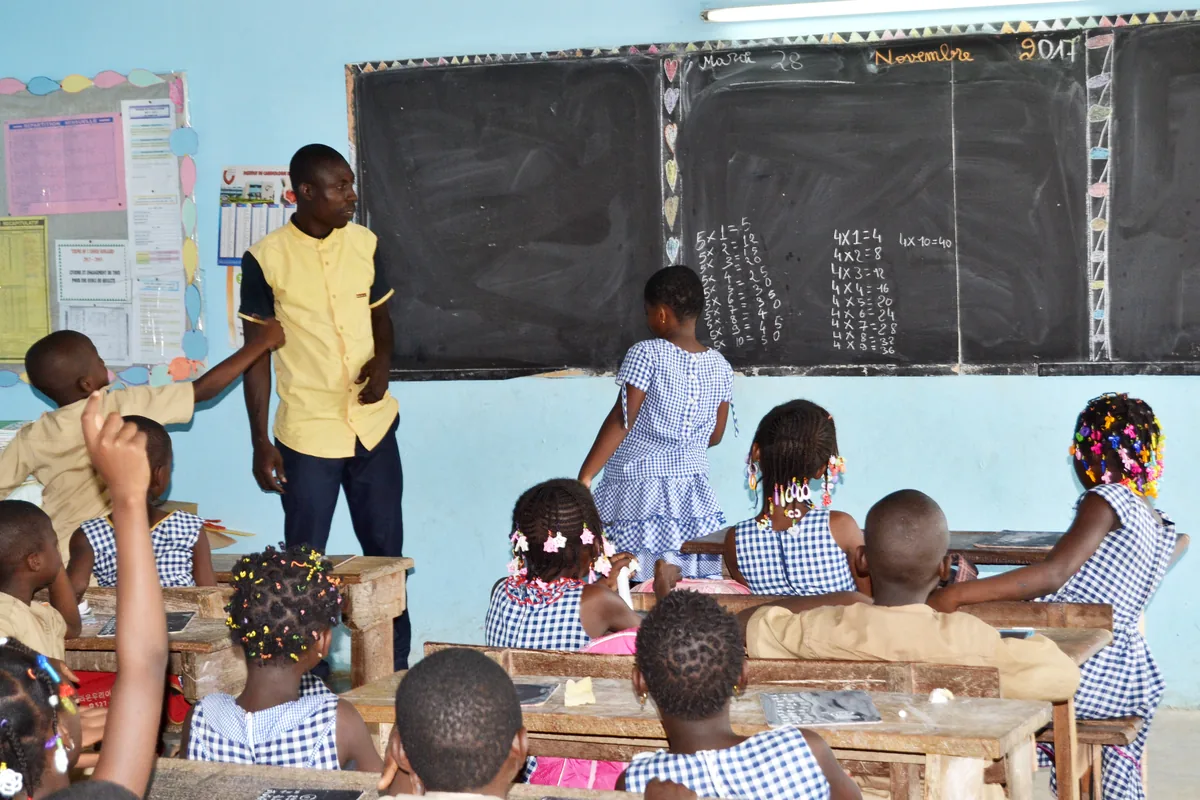
A text from the very start of the school year
The text appears in the CP1 reader used in Côte d’Ivoire from the 1980s onward, and it was kept in the 1997 edition. It isn’t just one lesson among many: the textbook labels it “LESSON 1”. Simple sounds, made to be sounded out syllable by syllable and then recited in chorus — and the sentence given twice, in print and then in cursive, because you also had to learn to write it.
Hence its place in collective memory: we didn’t read it once, we chanted it dozens of times, standing up, the whole class together. In the 1997 edition, the text is on page 6 — it was reworked in the textbooks that followed, then disappeared after 2005.
The one everyone mentions first
Ivorians in their thirties, forties or fifties love to swap the memorable sentences from their first lessons — Papa’s motorbike, Ama’s boubou — and everyone stands up for their own generation’s.
But “Mariam joue à la balle” has a status all its own.
A girl, a ball, in 1980
There’s a reason for that, beyond nostalgia. In a 1980s reading book, showing a girl playing ball was no small thing: football, in the schoolyard as in the street, was boys’ territory.
Without any speech, those five words gave a little girl a place in a game that wasn’t meant for her.
And then, the next lesson
In CP1, Mariam played ball. Nobody ever found out against whom, or whether she won. The textbook stopped there: one sentence, one drawing, and on to the next page.
Thirty years later, we have the answer.
Where to find the old reader?
Let’s be frank: we don’t sell it, and we don’t have it. School editions from that era disappeared from bookshops long ago; the copies still in circulation are attic finds, traded between private individuals.
Facebook groups devoted to “the good old days” and forums about old textbooks are, as far as we know, the only places where the hunt has a chance of succeeding. If you find one, hold on to it: it’s a piece of the history of Ivorian schooling.
What we can offer you is the rest of the story.
Mariam has grown up
In 2022, the Ultimes Griots team — a publishing house in Abidjan — took up the legendary sentence and turned it into a comic book. Mariam now has a neighborhood, Gloglo, in the back streets of Abidjan; friends, Adjoua the little choco and shy Junior; a grandmother, Nan, who has something to say about everything; a coach, Kalou; and above all a dream nobody around her takes seriously: becoming a football star.
Not in a stadium — playing maracana, Ivorian-style neighborhood football, on a dusty pitch, with two tires for goalposts.
The nod is there from the title: the comic is called Mariam Plays Ball, subtitled The New Legend of the Maracanã. It was launched in Abobo in February 2022, in the middle of the Africa Cup of Nations. The little girl from the reading page has become a heroine on paper, with a personality, doubts and opponents.
What hasn’t changed is the meaning. In the 1980s, a girl playing ball in a schoolbook was a door left ajar. In 2022, a girl who wants to become a footballer in an Ivorian comic is the same door, pushed a little harder — for today’s Mariams, and for the boys who will read alongside them.
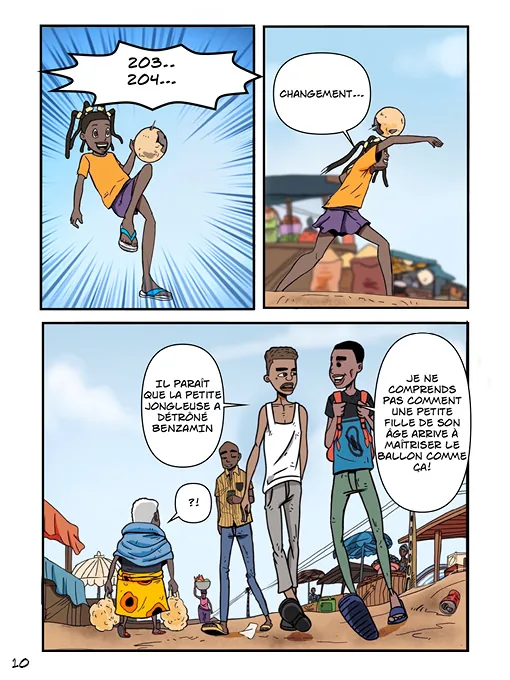
What’s inside the comic book


Mariam Plays Ball
The four episodes of “The New Legend of the Maracanã”, collected in a single volume.
- All four episodes in one volume. The New Legend of the Maracanã reads in one sitting, with no need to hunt for the rest elsewhere.
- An Ivorian story from start to finish. The nouchi of the back streets, maracana, the sharp-tongued grannies, the big brothers who don’t believe in anything — and the city of Abidjan as a character.
- Artwork designed for children from primary school onward, and a story that speaks to parents too: the very ones who learned to read with the first Mariam.
- An ISBN, an Ivorian publisher, careful printing. This isn’t a fanzine; it’s a book that holds its own on a bookshelf.
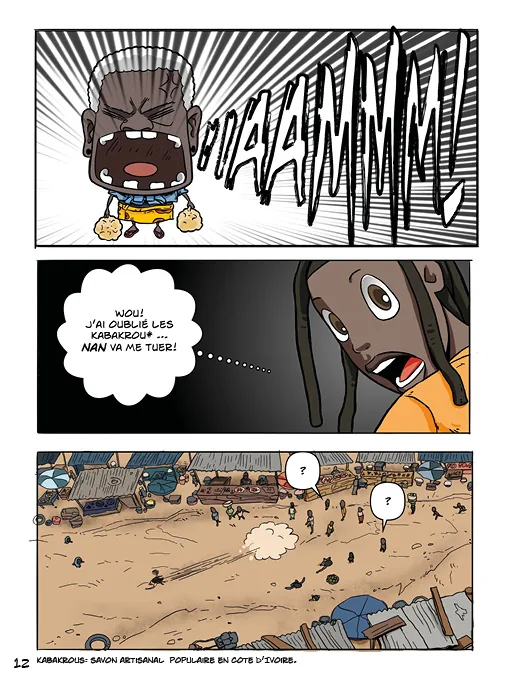
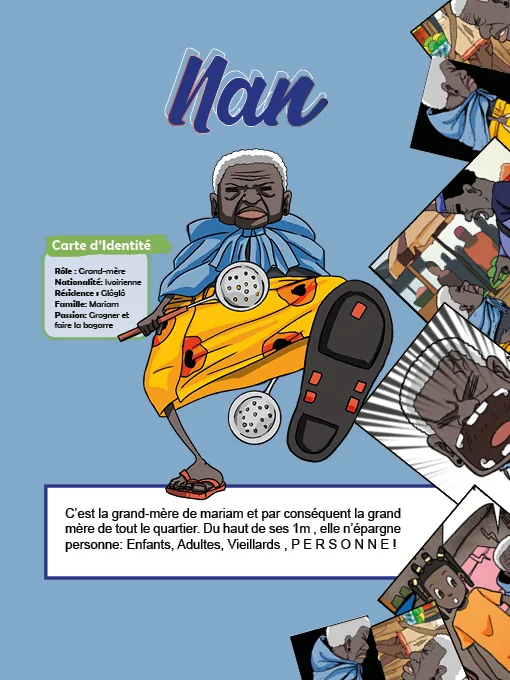
The three pages shown here are taken from the book. The recommended age is our editorial recommendation, not something printed on the album. Shipped from Abidjan; free delivery from 32,800 F CFA.
Frequently asked questions
Do you sell the old CP1 reader?
No. We don’t sell it and we don’t have it. School editions from that era disappeared from bookshops long ago; the copies in circulation are attic finds, traded between private individuals. Facebook groups devoted to school memories and forums about old textbooks are, as far as we know, the only places where the search has a chance of succeeding.
Is the comic the same book as the school textbook?
No. It’s an original comic book, inspired by the sentence in the reader. It takes up the character and the title, then tells what the textbook never said: Mariam has grown up, she lives in Abidjan and she wants to become a football star.
From what age can children read the comic?
From age 7, for a child who is already comfortable reading. That’s our editorial recommendation: no age range is printed on the book. It works very well read together, and parents who learned to read with the first Mariam will enjoy it too.
How many episodes does the volume contain?
Four. The volume brings together the four episodes of “The New Legend of the Maracanã”: the story reads in one sitting, with no need to hunt for the rest elsewhere.
Do you deliver outside Côte d’Ivoire?
Our online shop delivers in Côte d’Ivoire (2,000 F CFA, free from 32,800 F CFA, or pickup in Abidjan-Angré). Outside Côte d’Ivoire, our books are distributed by resellers such as La Boutique Africavivre and Amazon, depending on the title.
Go further
- The Our Heroes collectionThe Awakening of the Jeli and Dissongo, two volumes of African fantasy.
- African folktales for childrenWhy and how to pass on the stories of home.
- The directory of African baby names252 names, with their meaning and origin.
- Which African folktale book should you choose?The guide by age and by use, across all publishers.
Mariam plays ball. She never stopped.